What Is Digital Dentistry? A Complete Guide for Patients
Overview
Walking into a modern dental clinic in 2026 feels nothing like it did a decade ago. The gooey impression trays, the long waits for lab-made crowns, and the guesswork of two-dimensional X-rays are rapidly being replaced by sleek scanners, 3D printers, and AI-assisted diagnosis. If you have ever wondered what is digital dentistry and why your dentist keeps mentioning it, you are not alone. Patients across India, especially in cities like Thane, Mumbai, and Pune, are now asking the same question. This guide explains the meaning of digital dentistry, the technologies behind it, and how it directly improves your treatment experience, comfort, and long-term results.
TL;DR / Quick Answer
Digital dentistry is the use of advanced digital technologies, such as intraoral scanners, CAD/CAM systems, 3D imaging, 3D printing, and AI-assisted diagnostics, to plan and deliver dental care with greater precision, speed, and comfort. For patients, it means fewer repeat visits, more accurate crowns and implants, predictable Invisalign outcomes, and minimally invasive procedures. In 2026, digital dentistry is no longer a premium add-on; it is fast becoming the standard of care in leading clinics across India.
Table of Contents
- What Is Digital Dentistry and How Does It Work?
- Key Technologies Used in Digital Dentistry Today
- How Digital Dentistry Improves Diagnosis and Same-Day Restorations
- Digital Dentistry in Orthodontics, Invisalign, and Cosmetic Care
- Benefits of Digital Dentistry for Patients
- Why Choose a Digital Dental Clinic in Thane
- The Future of Digital Dentistry in 2026 and Beyond
- Book a Digital Dentistry Consultation in Thane
What Is Digital Dentistry and How Does It Work?
Digital dentistry refers to the use of computer-based tools and digital workflows to diagnose, plan, and execute dental treatments instead of relying solely on physical molds, manual X-rays, and handcrafted lab work. The American Dental Association describes digital dentistry as a connected ecosystem where intraoral scanners, cone-beam CT, CAD/CAM design software, 3D printers, and AI-driven imaging systems all work together to deliver faster and more accurate care. You can read more about how this is delivered in practice on the Digital Dentistry at The Dental Solutions service page.
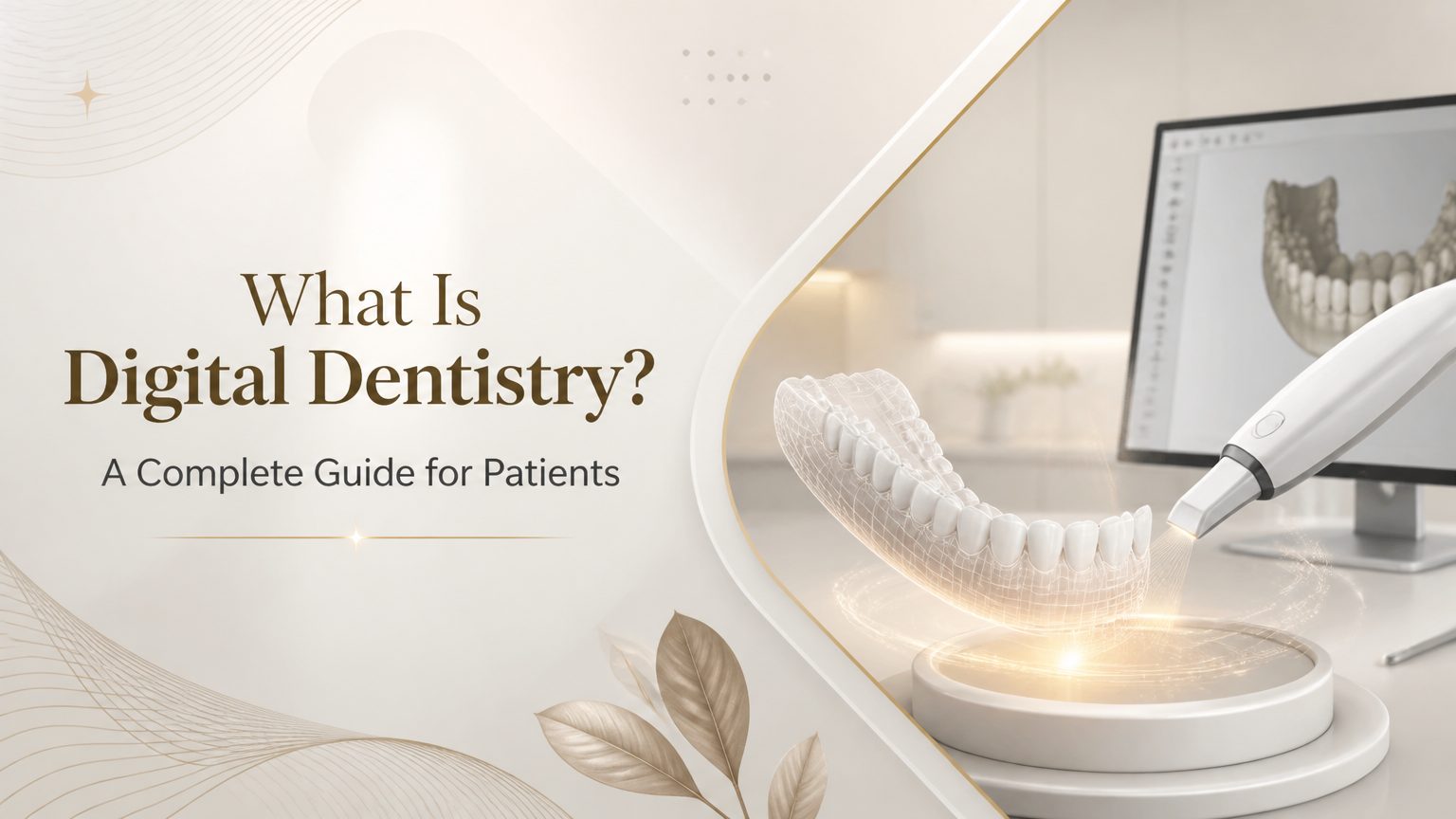
In practical terms, when you visit a digital dental clinic, your dentist uses a handheld wand-shaped scanner to capture a 3D image of your teeth and gums in minutes, rather than asking you to bite into a tray of putty. That scan is then fed into software that designs a crown, aligner, surgical guide, or smile mock-up with micrometer-level accuracy. The design is sent to an in-house milling machine or 3D printer, and in many cases your final restoration is ready the same day. This is why the question of what is digital dentistry is best answered not with a textbook line but with a description of the patient journey inside a fully equipped clinic.
This shift matters because it shortens the treatment chain. The traditional route, involving physical impressions, a third-party dental lab, multiple try-ins, and several appointments, is being replaced by a same-visit, clinic-controlled workflow. Patients benefit from fewer injections, fewer temporary restorations, and far less waiting. A 2025 randomized clinical trial published in PubMed Central confirmed that digital impressions cut chair time nearly in half (12.6 minutes vs. 25.8 minutes) and earned significantly higher patient comfort scores than traditional putty impressions.
Key Technologies Used in Digital Dentistry Today
Several core technologies together make up a modern digital dental practice. Understanding them helps you ask the
right questions at your consultation, and helps you judge whether a clinic truly offers what is digital dentistry or is simply using a single scanner as marketing.
Intraoral scanners are the starting point. Devices like iTero, 3Shape TRIOS, and Medit replace the gag-inducing impression tray with a small camera that captures thousands of images per second and stitches them into a precise 3D model of your mouth. This data becomes the foundation for nearly every digital treatment that follows, from aligners to implant guides.
CAD/CAM (Computer-Aided Design and Computer-Aided Manufacturing) software allows your dentist or an in-house technician to design crowns, bridges, veneers, and inlays on a computer screen. The design is then sent to a milling machine that carves the restoration from a block of ceramic or zirconia, or to a 3D printer that builds surgical guides, denture bases, and aligner models layer by layer.
Cone-beam computed tomography (CBCT) provides three-dimensional X-ray images of your teeth, jawbone, nerve pathways, and sinuses. Unlike traditional panoramic X-rays, CBCT lets the clinician see the exact width, height, and density of your jawbone before placing an implant. Digital occlusal analysis systems, including T-Scan and Tek Scan digital occlusal analysis, measure how your upper and lower teeth meet and slide against each other in real time, which is critical for diagnosing bite problems and balancing new crowns.
How Digital Dentistry Improves Diagnosis and Same-Day Restorations
Diagnosis is where digital dentistry delivers some of the most meaningful gains for patients. In January 2025, the American Dental Association published Technical Report No. 1109, formally defining evaluation standards for AI systems that read dental X-rays for cavities and periodontal disease. Combined with intraoral photos and 3D scans, AI can now flag early enamel lesions and bone loss that are easy to miss with the human eye, giving you a reliable second opinion on every image. This is one of the clearest ways to explain what is digital dentistry at the diagnostic level.
In restorative care, same-day crowns have become a flagship application. After scanning the prepared tooth, your dentist designs the crown on CAD software, mills it from a solid ceramic block in roughly 10 to 15 minutes, and cements it in the same appointment. There is no temporary crown, no second injection, and no waiting for a lab to ship the final piece. Mordor Intelligence reports that CAD/CAM systems are the single largest revenue segment in the global digital dentistry market, which reached USD 9.61 billion in 2025 and is projected to hit USD 10.53 billion in 2026.
For dental implants, digital planning transforms a once-imprecise surgery into a guided procedure. Using CBCT scans and intraoral scans merged in software, your surgeon plans the exact angle, depth, and position of each implant before surgery. A 3D-printed surgical guide is then placed over your gums during the procedure, ensuring the implant goes exactly where it was planned. Patients exploring digitally planned dental implants typically experience shorter surgery times, smaller incisions, and faster healing compared with freehand placement.
Digital Dentistry in Orthodontics, Invisalign, and Cosmetic Care
Orthodontics is one of the areas where digital workflows have changed the patient experience the most. Traditional braces still work well, but the planning behind them is now almost entirely digital. Your orthodontist takes a quick intraoral scan instead of a putty impression, then uses software to map every tooth movement from start to finish. You can usually preview your expected smile before treatment even begins, which is a powerful shift for anyone nervous about the outcome.
For clear aligners l
ike Invisalign, this digital roadmap essentially is the treatment. A series of aligners is 3D-printed based on the software's staged movements, and each tray moves your teeth incrementally. Because the plan is visualized and simulated in advance, refinements are more predictable and the total number of visits is often lower than with conventional braces. Patients exploring digital orthodontics including Invisalign benefit from precise fit, fewer mid-course corrections, and shorter overall chair time.
Cosmetic dentistry has been transformed in equal measure. Digital smile design software lets you see a realistic preview of veneers, whitening, or a full smile makeover on your own photograph before committing to any treatment. Combined with in-house or same-day ceramic fabrication, this means veneers and crowns can be designed to match your facial proportions, lip line, and gum contours with remarkable accuracy. Anyone considering digital smile makeover treatments can now approve the look before any drilling begins, which removes much of the anxiety that used to come with cosmetic work.
Benefits of Digital Dentistry for Patients
The clinical advantages of digital dentistry translate into very real, very practical benefits for you as a patient. They go far beyond the technology itself and directly affect how your visit feels, how long it takes, and how long your treatment lasts.
First, comfort. Digital scanners eliminate the need for bulky impression trays filled with putty that trigger gagging in many patients. The 2025 PMC clinical trial found that patients rated the digital impression experience 8.6 out of 10, compared to 6.1 for traditional putty. Second, speed. Same-day crowns, in-house 3D printing of surgical guides, and digital treatment planning mean fewer appointments and less time off work. Third, accuracy. Digital impressions reduce marginal-fit errors on crowns and bridges to around 24.5 micrometers, compared to 43.2 micrometers for conventional impressions in full-mouth rehabilitation cases, and that precision directly affects how long your restoration lasts.
Fourth, predictability. Because the entire treatment is planned and simulated in software before any drilling begins, you know what the outcome will look like, and your dentist knows exactly which steps to follow. Fifth, minimally invasive care. Digital tools allow your dentist to preserve more of your natural tooth structure, place smaller incisions for implants, and design thinner veneers that require less enamel removal. Finally, better communication. Digital scans, 3D models, and before-and-after simulations make it far easier for you to understand your diagnosis and make informed decisions, which is the foundation of digitally guided general dentistry.
Why Choose a Digital Dental Clinic in Thane
Thane has quietly become one of Maharashtra's fastest-growing hubs for advanced dental care, and choosing a digital dental clinic here gives you access to technology that, until a few years ago, was available only in large corporate hospitals. A clinic that has invested in intraoral scanning, CBCT, CAD/CAM, digital occlusal analysis, and 3D printing is essentially a one-stop solution for most dental needs, from routine fillings to full-mouth rehabilitation and implant surgery.
When evaluating a clinic, look for NABH accreditation, which signals that the practice follows nationally audited quality and safety standards, in-house milling and printing capabilities so that your treatment is not held up by an outside lab, transparent digital treatment plans that show you scans, designs, and timelines upfront, and a multidisciplinary team that includes orthodontists, periodontists, and implantologists rather than a single generalist
handling complex cases. You can learn more about the clinic's background, philosophy, and quality benchmarks on the About The Dental Solutions clinic page, and read the credentials of the specialists on the Meet our expert dental team page.
The The Dental Solutions – Dental Clinic in Thane Majiwada brings all of these capabilities under one roof, supported by structured patient journeys, minimally invasive protocols, and continuous post-treatment follow-up. Real patient experiences shared on the Patient Stories and Testimonials page give you a candid view of what to expect from diagnosis to final results.
The Future of Digital Dentistry in 2026 and Beyond
The pace of change in digital dentistry shows no sign of slowing. The ADA's concept of "connected dentistry" envisions a future where your dental records, scans, aligner designs, and implant plans flow seamlessly between your dentist, the lab, and any specialist you might be referred to, reducing errors and duplicated work. The same ADA News feature highlights that connected ecosystems will soon make second opinions and remote case reviews routine, especially for patients in smaller cities who do not have easy access to specialists.
AI is set to move from a screening tool to a true clinical partner. With the ADA's 2025 technical report providing formal performance benchmarks, expect to see more clinics using AI to detect early decay, gum disease, and even oral cancer markers on routine scans. 3D printing will continue to expand beyond surgical guides and models into final restorations, dentures, and custom orthodontic appliances, dramatically cutting turnaround times. Mordor Intelligence projects the global digital dentistry market to reach USD 16.67 billion by 2031, a clear sign that investment, research, and patient demand are all pointing the same way.
For patients, the practical takeaway is simple. When you choose a clinic that has invested in these tools, you are not just buying a single procedure; you are choosing a level of precision, comfort, and predictability that traditional workflows simply cannot match. Asking whether your dentist uses digital impressions, digital treatment planning, and same-day fabrication is one of the smartest questions you can ask before starting any major treatment.
Conclusion
Understanding what is digital dentistry is the first step toward choosing modern, evidence-based dental care. From AI-assisted diagnosis and digital impressions to same-day crowns, guided implant surgery, and 3D-printed clear aligners, digital tools have reshaped nearly every step of the patient journey. They deliver greater comfort, fewer visits, more predictable results, and longer-lasting restorations. If you are considering any dental treatment in 2026, make digital capability a non-negotiable part of your checklist.
Ready to experience the difference? Book Your Appointment at The Dental Solutions for a digital dentistry consultation in Thane Majiwada, or explore all our dental treatments to see which service fits your needs best.
FAQs
What is digital dentistry in simple terms?
Digital dentistry means using computer-based tools, like 3D scanners, CAD/CAM design, 3D printing, and AI imaging, to diagnose, plan, and deliver dental treatments with greater precision, comfort, and speed than traditional methods.
Is digital dentistry better than traditional dentistry?
Digital dentistry offers clear advantages in accuracy, comfort, and turnaround time. Digital impressions are more comfortable, same-day crowns eliminate the
need for temporaries, and guided implant surgery improves precision, though the skill of your dentist still matters most.
How much does digital dentistry cost in India?
Costs vary by procedure, clinic, and city. A digital consultation is often included in the overall treatment fee, while same-day crowns, guided implants, and Invisalign are priced at a premium compared with conventional workflows. Most clinics offer EMI options to make advanced care more accessible.
Is digital dentistry safe?
Yes. Digital systems used in leading clinics are approved by regulatory bodies and, in many cases, are now held to formal performance standards such as the ADA Technical Report No. 1109 for AI in dental imaging, published in 2025.
What treatments can be done with digital dentistry?
Almost every modern treatment benefits from digital workflows, including crowns and bridges, veneers, smile makeovers, root canals, dental implants, clear aligners like Invisalign, dentures, and TMJ/bite analysis.
Does digital dentistry reduce the number of dental visits?
In many cases, yes. Same-day crowns, digital treatment planning, and 3D-printed surgical guides can remove the need for multiple try-in visits, temporary restorations, and long lab waits.
How do I know if my dentist uses digital dentistry?
Ask whether the clinic uses an intraoral scanner instead of putty impressions, has CBCT or 3D imaging, offers same-day crowns, and uses digital software to plan implants or aligners. A clinic that answers yes to most of these is genuinely digital.
Who is a good candidate for digital dental treatments?
Almost anyone. From a simple single crown to a full-mouth rehabilitation or surgical implant case, digital workflows can be tailored to patients of all ages, provided they are treated by a trained and accredited dental team.
 +91-9920744926
 139, 1St Floor,
Lodha Boulevard,
Majiwada, Thane West -400601
 Mon- Sat: 11:00 am to
8:00 pm

 Home /